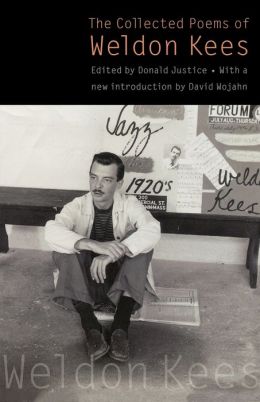
Showing posts with label Weldon Kees. Show all posts

Friday, March 7, 2014

“The Cabinet of Simplicity”


“The Cabinet of Simplicity”

Awhile back, Glen Armstrong pointed me in the direction of Weldon Kees and Kenneth Fearing, two essentials that never made it into my literary education.  There’s an uncanny familiarity about them, especially reading back to them through the New York School and others.  A favorite for me of Fearing’s selected poems is “The Cabinet of Simplicity”, which begins as a kind of manifesto, the kind of manifesto that might actually be acceptable.


    It will be known as Doctor Barky’s cabinet, a new magic
        Something for which there can be no substitute.
        May be used as an ornament or worn like a hat.
        Neat.  Genteel.
        Doctor Barky’s patented magic cabinet of strict, strict
             simplicity.

If others might hold the whole universe in the palms of their hands, Doc Barky, rather, shoves it all into his drawers, these special drawers as a part of this special cabinet.

What is this cabinet?  Could be his “order of things”.  But whatever it is it’s more magical than scientific.  Yet whimsy gives way to “discords struck from violent streets” and “death” and then, more convincing, to a dark dreamland where “he cut off his head and gave it to / a girl with stone lips”, her body “burned from within.” Later he’s “dining on her lips.”  Somehow there appears to be a connection between cannibalizing stone lips by way of a decapitated head and Barky’s need: “a need to arrange the / world so that he can understand it, / And still more, to create a fixed world.”  I start off liking Barky from the start with his magic cabinet and supposed naiveté, but by this point I become horrified by what might happen as he imposes this “fixed world” if it extends much beyond this cabinet.


But then each drawer of the cabinet is designated by Barky for this and that, and his order of things seems tame again.  “The doctor has finished.  /  He steps back into the shadows forever.”  So Fearing asserts, really as a set up, because candles continue to burn around “the magic box” and “the mechanical heart draws into itself / The veins and arteries of chaos” or perceived chaos in Barky’s universe.  Fearing has been amping us up for a final kicker:

    Comrade, this is no poem,
      Who touches this
      Touches Doctor Barky’s patented magic cabinet of
           certified, strictly guaranteed simplicity and
           truth.


-bbc


Thursday, December 19, 2013

"Xantha Street"

"Xantha Street" is what gets me.  Kees has the "angels rise" but it's "on page 289" and even though this is done "splendidly" and "to Heaven", nevertheless "the evening still comes on."  

I go back to that idea again and again of the odd detail or the minor or mundane particular that in a moment takes over the whole scene.  Roland Barthes described this as the punctum and Mieke Bal as the navel, among others.  

"The climate of murder hastens newer weeds" and death's all around, you're "frantic, but proud of penmanship.  Beasts howl outside; / Authorities, however, keep the pavements clean." 

What's that slide that takes place in existence from what's taken to be important to what's not so that what's not entirely trumps the other and then becomes what is?  See page 289.  Feel the evening come on.  Note the penmanship and pavement.  Ponder the bellybutton and laugh, or get the point.  Your own point as you see it, a Barthian punctum amidst the studium.  -bbc 


Friday, November 22, 2013

"The Smiles of the Bathers"


"The Smiles of the Bathers"

I’ve been reading Weldon Kees’ poem, “The Smiles of the Bathers,” and thinking about the line, “Water and wind and flight, remembered words and the act of love." It’s a list with seven stressed syllables. Out of context, and divorced from its perfect pulse, it reads a bit too primal, as if perhaps the poet has allowed himself to be carried too far away from the twentieth century’s grit and tight, sidewalk pivot by bloated universals. But Kees is better than that. The above list is neither – could never be – the poem’s opening or closing line. Instead, it’s the poem’s central metaphor. I think we know, or at least intuit, that any list has a tendency toward litany, invocation and prayer when included in a poem. The string of concepts, however, has to be considered together and, thus, constitutes a type of metaphor.


Kees frames all of the above as “perfect and private things, walling us in” with their “imperfect and public ending.” They are “interruptions.” And the bathers, lovers, scholars and pilots from the first four lines, all solid, tax-paying citizens of the above twentieth century, cannot bank on momentary smiles. They, ironically, cannot even bank on death’s ultimate interruption, for there is “No death for [them.] [They] are 

involved.”

                    - G.F.A.